
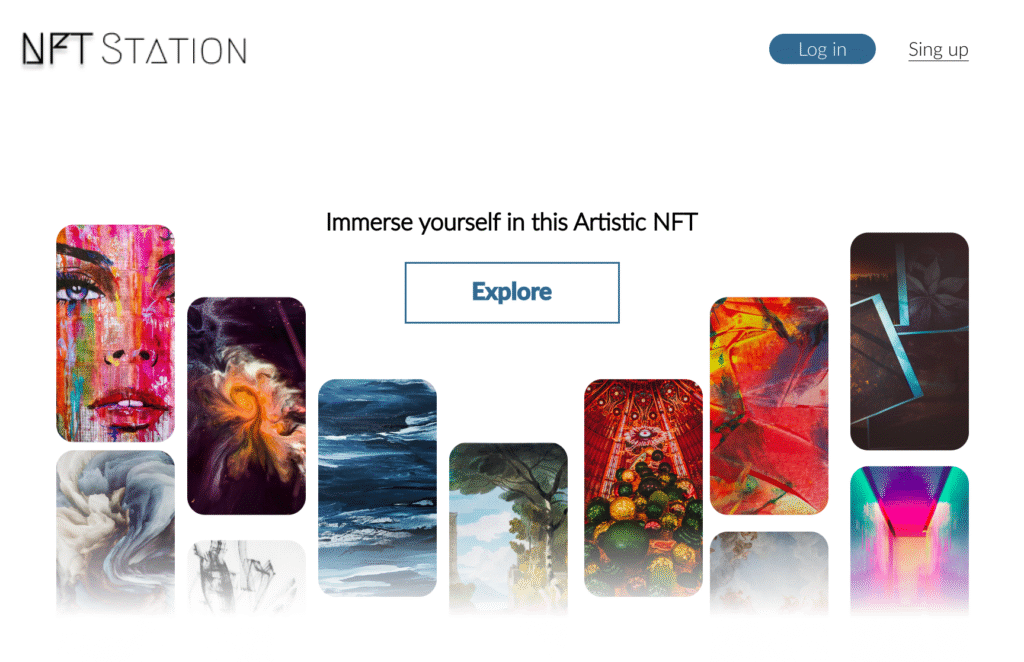
In this project, I present NFTStation, an academic and technical experiment developed as my final undergraduate thesis, focused on exploring Ethereum, smart contracts, and NFTs (Non-Fungible Tokens) through a real-world software implementation.
The main goal of this work is to demonstrate how decentralized technologies are transforming digital ownership and transactions. By leveraging the Ethereum blockchain, NFTStation showcases how smart contracts can be used to create, manage, and trade NFTs in a secure, transparent, and automated way—without relying on centralized intermediaries.
NFTStation is an MVP of an NFT marketplace, allowing users to connect their wallets via MetaMask, mint NFTs, list them for sale, and perform transactions directly on the blockchain. The project adopts the ERC-721 standard, ensuring uniqueness and authenticity of digital assets, and uses Solidity for smart contract development.
On the backend, tools such as Hardhat, OpenZeppelin, and Ethers.js were used to develop, deploy, and interact with smart contracts in a local Ethereum environment. For decentralized storage of NFT metadata and assets, the system integrates IPFS through Infura, reinforcing the decentralized architecture of the solution. Blockchain transactions can also be tracked transparently using Etherscan.
Beyond the technical implementation, this project analyzes the social and economic impacts of blockchain technology, highlighting its applications in areas such as digital art, finance, supply chains, and automated legal agreements. The research emphasizes how smart contracts can reduce bureaucracy, increase trust, and enable new business models in the digital economy.
This project represents a practical and educational exploration of blockchain development, serving as a foundation for future studies involving decentralized applications, NFT ecosystems, and the evolution of digital ownership.